Guide
Korean Plastic Surgery Before and After: How to Read the Photos Properly
Most people searching for korean plastic surgery before and after photos are trying to answer one private question: will this work on a face like mine? You scroll, you compare, and after fifty images you are no closer to knowing, because nobody explains what you are actually looking at.
I review photographs all day, and the ones that tell me something useful are dull to look at: same angle, same distance, same light, taken at a fixed point in healing. The dramatic pairs are usually the least informative. So this article is about reading, not browsing.
By the end you will know: which three technical details decide whether a pair of photos is comparable at all; what to look for specifically in eyelid, nose and jawline photos; how much of a "result" is still swelling at week one, month one and month three; and how to use your own photos to get a real answer from a surgeon rather than a guess.
Why korean plastic surgery before and after photos mislead people
A photograph records the camera as much as the face. Move the lens up and the chin shortens; move it down and the jaw widens. Shoot under a ceiling light and the mid-face falls into shadow, which reads as flat cheeks and heavy eyes.
Add a change in hairstyle, makeup, posture or weight between the two shots and you have a pair that shows a different person, not a different result. None of that is fraud. It is simply what happens when two images are taken months apart without a protocol.
Before you draw a conclusion from any image, run through this:
- Is the camera at eye level in both frames, or is one shot from above?
- Is the face the same size in the frame, or has the subject moved closer?
- Is the light from the front in both, or from overhead in one?
- Is the expression neutral in both, or is one smiling?
- Is there a stated time point after surgery, or just "after"?

How to read before and after photos, angle by angle
We photograph patients in a fixed set of views because each one answers a different question. A front view tells you about symmetry and width. A 45-degree view tells you about cheekbone projection and how the nose tip sits against the cheek. A true side profile tells you about bridge height, chin projection and the line from chin to neck.
Judging a nose from a front photo alone is the most common mistake I see. Judging a jawline from a smiling photo is the second. When you look at galleries, including our own before-after page, sort what you see by view before you compare anything.
| View | What it shows reliably | What it hides |
|---|---|---|
| Front, eye level | Symmetry, facial width, eyelid crease height | Bridge height, chin projection |
| 45 degrees | Cheekbone projection, nose tip definition | True midline deviation |
| Side profile | Nose bridge and tip angle, chin and neck line | Left-to-right asymmetry |
| Closed eyes, front | Eyelid crease shape and scar line | How the crease looks in movement |
Results vary between individuals, and a view that flatters one bone structure can be unkind to another. That is why we shoot all four rather than choosing one.
Double eyelid surgery before and after: what to look at
With eyelid photos, most people look at how big the eyes appear. I look at four other things: where the crease sits relative to the lash line, whether the two sides match, whether the crease holds its shape when the eye is open and moving, and whether the eyelid is opening properly at all.
That last point matters more than the crease itself. If the levator muscle that lifts the eyelid is weak, a new crease alone can still leave the eye looking sleepy, which is why ptosis correction is often planned alongside double eyelid surgery. A photo can suggest this; an examination confirms it.
The method also changes what an early photo means. The non-incisional method forms the crease through five to seven micro holes, with stitches out after about 3-5 days if needed and daily activities resumed in 3 days. The incisional method runs along a designed line so skin, fat and muscle can be adjusted at the same time, with stitches out after 5-7 days and daily activities in 5-7 days. An "after" photo at day 4 means something different for each.
- Crease height: does it follow the natural curve, or sit high and straight?
- Symmetry: compare the distance from lash line to crease on both sides.
- Opening: how much of the iris is visible above the lower lid?
- Corners: has the inner or outer corner been changed with canthoplasty, which has its own timeline: stitches out after about 7 days, daily activities in 3-5 days.
Rhinoplasty before and after: the profile is only half of it
Nose photographs are where patients most often compare the wrong pair. A bridge that looks dramatically higher may simply be a side shot taken at a different height. What I check is the relationship between the bridge and the tip, because our approach to augmentation rhinoplasty adds cartilage at the tip and places an implant along the bridge precisely so the two stay balanced with each other.
Timing matters even more here than with eyelids. After augmentation rhinoplasty, stitches come out after about 10 days, there are two visits for stitch removal, and daily activities resume in 7-10 days. Any photo taken before the splint comes off is a photo of a splint, not a result.
| Procedure | Stitches | Daily activities | Why early photos mislead |
|---|---|---|---|
| Augmentation rhinoplasty | About 10 days | 7-10 days | Tip definition is masked by swelling |
| Hump removal | About 10 days | 7-10 days | Bridge line looks straighter under swelling |
| Deviated nose correction | About 10 days | 7-10 days | Bone position settles after osteotomy |
| Alarplasty | 7-10 days | 3 days | Nostril width reads wider while healing |
| Revision rhinoplasty | About 10 days | 5 days | Scar tissue from the previous surgery changes the timeline |
If breathing is part of your reason for surgery, a photo will never show it. Functional rhinoplasty addresses rhinitis, sinusitis, a deviated septum and nasal valve stenosis alongside shape, and that half of the result is invisible in any gallery. Individual outcomes differ.
Facial contouring photos: bone, soft tissue and shadow
Jaw and cheekbone photographs are the hardest to read, because what you see is bone covered by muscle, fat and skin. Remove bone and the soft tissue has to be handled too, which is why jaw reduction may also address the outer cortical layer, the masseter muscle and the buccal fat pad depending on the diagnosis, and why cheekbone reduction repositions tissue to prevent the cheeks sagging or hollowing.
The timelines are long and the incisions are inside the mouth, so there is no external scar to read. Jaw reduction involves 1 night in hospital, stitches after about 14 days, two visits for stitch removal, and daily activities in 5 days. Two-jaw surgery is a different scale altogether: about 5 hours, general anaesthesia, 3 nights in hospital, stitches after about 14 days, 3-4 visits for stitch removal, and a stay in Korea of at least 3 weeks.
When comparing contouring photos, look at the shadow under the cheekbone and the line running from the ear to the chin in the 45-degree view. Those two areas change most, and they are also the two most easily faked by lighting.
What the timeline actually looks like, stage by stage
Patients often send me a photo at day five, worried. Almost always, they are comparing a swollen face to an unswollen one and calling the difference a result. Healing is not linear and it is not the same for every procedure, so we fix the checkpoints instead.
- Week 1-2. Swelling and bruising dominate. What we check is wound condition and pain that is getting worse rather than better. Contact your coordinator, who reaches the surgeon.
- Month 1. Shape begins to emerge as swelling settles. We check scar colour and any asymmetry between the two sides, from photos you send.
- Month 3. Scar maturation, and whether the result has settled where it was planned to. Photos again, same angles as your pre-operative set.
- Anytime. Fever, spreading redness, discharge, sudden pain, or a change in vision after eye surgery is not a follow-up item. See a doctor where you are, the same day, and tell us afterwards.
Complications such as bleeding, infection or inflammation may occur following surgery, and individual satisfaction differs. These checkpoints exist so that a problem is found early rather than at the end.
Seoul or home: what to compare before you decide
Photos are one input. The arrangements around the operation are another, and they are easier to verify than any image. The table below sets out what we state on our procedure pages against the questions worth asking wherever you are considering surgery.
| Point to check | Banobagi, Seoul | Clinic at home |
|---|---|---|
| Who administers anaesthesia | Anaesthesiologists employed full-time by the clinic | Varies by clinic |
| Who operates | The surgeon you consulted, recorded under the real-name system | Varies by clinic |
| Follow-up after you travel | Coordinator contact at week 1-2, month 1 and month 3 | Varies by clinic |
| Language support | 1:1 coordinator; staff languages include English, Thai, Korean, Japanese, Chinese, Vietnamese, Indonesian | Varies by clinic |
| Permission to treat international patients | Publicly searchable register held by the Ministry of Health and Welfare | Varies by country |
We do not publish fixed prices, and no honest before-and-after gallery can quote one either, because the fee follows the plan. Cost range is discussed in the consultation once we have seen your photos. Our pricing and consultation pages explain how that conversation is structured.
How to use your own photos to get a real answer
The fastest way to stop guessing from other people's images is to produce your own baseline. Stand facing a window so the light comes from the front, hold the camera at eye level about an arm's length away, keep a neutral expression, and take four frames: front, both 45-degree views, and a true side profile. For eyelids, add one front shot with eyes gently closed.
Send those with a sentence about what you want to change. An online session can settle which procedures suit that goal, roughly how long you need to stay in Korea, what recovery looks like week by week, the cost range, and which surgeon would take the case. It cannot settle the final surgical plan, measurements that depend on examination or imaging, whether a previous surgery or existing implant changes the approach, or anaesthesia clearance. Those are confirmed in person on the day you arrive.
- 01. Send photos and tell us what you want to change.
- 02. A coordinator matches the case to a surgeon and books a time.
- 03. You talk through options, stay length and cost range.
- 04. The plan is confirmed in person on the day you arrive.
If you want to see our standardised sets alongside written patient feedback, the reviews page and the eyes, nose and face sections sit next to the same procedure specifications quoted above.
One thing we do not recommend is deciding from a gallery of other faces. A pair of photos of a face that is not yours cannot tell you what your eyelid, nose or jawline will do, and fifty more images will not change that. Send your own four photos instead, and we will tell you what they can show and what has to wait for an examination.
Summary
- A before-and-after pair means nothing unless angle, distance and lighting match, and the time point after surgery is stated.
- Read eyelid photos for crease height, symmetry and eyelid opening, not for how large the eyes look.
- Read nose photos on the profile and 45-degree views, and ignore anything taken before splint and stitch removal at about 10 days.
- Facial bone results should be judged at month three; stitches come out at about 14 days and two-jaw surgery needs at least 3 weeks in Korea.
- Your own four standard photos are worth more than a hundred galleries, because they are the only face a surgeon can plan on.
Take the four photos described above in daylight, front and side, and send them on WhatsApp with one line about what bothers you. We will tell you what those photos can show and what has to wait for an examination in Seoul. Results differ from person to person, so the answer will be about your face rather than someone else's gallery.
Frequently asked questions
How much does Korean plastic surgery cost?
We do not publish fixed prices, because the fee depends on the procedure, whether it is a first operation or a revision, and what the examination shows. Send front and side photos on WhatsApp and we will give you a cost range and what it includes during the consultation, before you book a flight.
Can a surgeon promise my result will look like a photo I send?
No. A photo of someone else shows their bone structure, skin thickness and eyelid anatomy, not yours. We use reference photos to understand the direction you want, then explain which parts of that look your own anatomy can support. Results vary between individuals.
At what point after surgery is a photo worth comparing to my 'before'?
It depends on the procedure. For eyelid surgery the crease keeps settling for months; for nose and facial bone surgery the shape continues to refine over a longer period. We ask for photos at week 1-2, month 1 and month 3 so the comparison is made at fixed points rather than at random.
Why do some before photos look worse than the person actually looked?
Downward camera angle, overhead lighting and a neutral, unsmiling face all flatten the mid-face and deepen shadows. That is why we ask patients to compare pairs shot at the same angle, distance and lighting, and to ignore any pair where those three differ.
Can I have an online consultation before travelling to Seoul?
Yes. An online session can settle which procedures suit what you want to change, roughly how long you need to stay in Korea, what recovery looks like week by week, the cost range and which surgeon would take the case. It is a consultation and a plan, not a diagnosis.
How do I check that a Korean clinic is allowed to treat international patients?
Under Korean law, only clinics registered with the Ministry of Health and Welfare may treat international patients, and the register is publicly searchable. Check the register yourself rather than relying on a claim on a website.
Do you keep in contact after I fly home?
Yes. Your coordinator checks in at week 1-2 on swelling, bruising and wound condition, at month 1 on shape and symmetry with photos, and at month 3 on scar maturation. Fever, spreading redness, discharge, sudden pain or a change in vision after eye surgery means seeing a doctor locally the same day and telling us afterwards.
Sources
Results and recovery differ from person to person. This article is general information, not a diagnosis — your surgeon confirms what suits you at consultation.
Keep reading
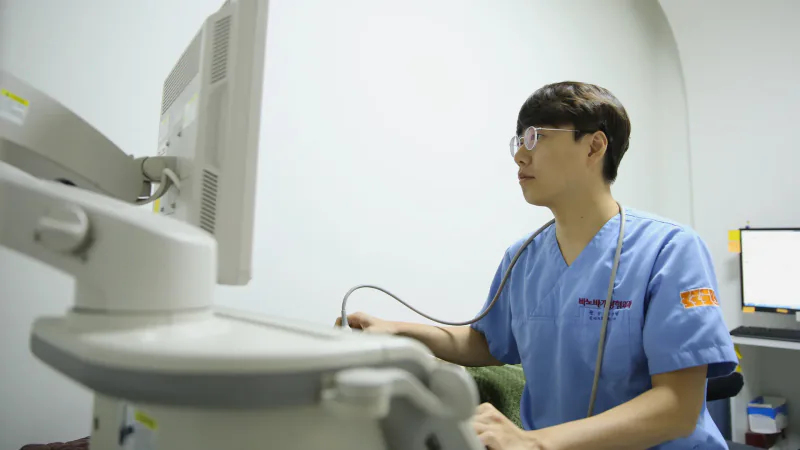 How to Check a Medical Tourism Clinic Licence in KoreaHow to check a medical tourism clinic licence in Korea, verify a board-certified plastic surgeon, and what to ask. Send two photos on WhatsApp.
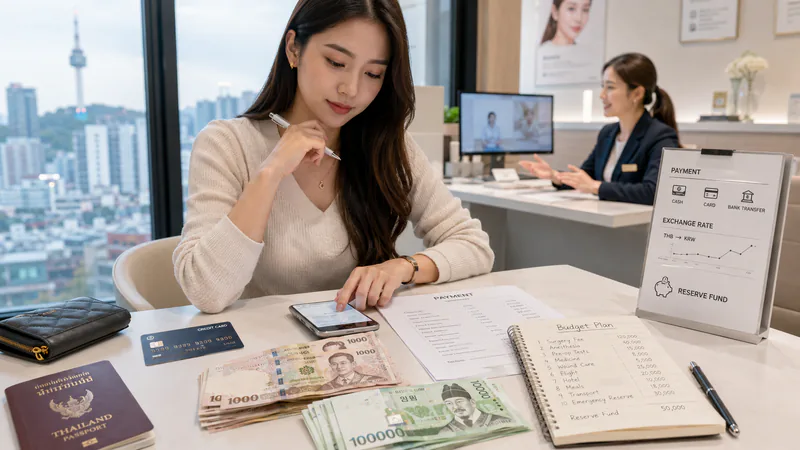 Plastic Surgery in Korea: How Much Will Your Plan Cost?Plastic surgery in Korea, how much? Why a price list misleads, what changes Korean plastic surgery cost and how to get your quote. Send 2 photos on WhatsApp.
 Plastic Surgery in Korea for Foreigners: Steps, Stay and AftercarePlastic surgery in Korea for foreigners: how consultation, safety checks, stay length in Seoul and aftercare work. Send two photos on WhatsApp for a plan.